Technology Integration Like Crayons in The Classroom #231
Technology Integration Like Crayons in The Classroom
There was a time in my life when I was new to all types of technology.
I was in Jr High and all students learned how to find home row on a typewriter.
Then, we gradually found our way to the computer lab.
Only then did each of us learn how to format a floppy disk and write simple code to understand the basics of the computer system.
Think back to when that may have been true for you.
The opposite could also have been true.
Perhaps you are one who has always had technology integrated into your world like crayons.
Perhaps you are one who has always had technology ‘integrated into your world like crayons in the classroom’.
That is part of a quote that I’ve had on my office wall at home for such a long time.
The simple saying feels like a part of me.
It could be why I came to know this for myself.
How could this happen?
When our son needed technology to become a part of his everyday world when he survived an illness at the age of two years old, I needed to learn more about all kinds of technology
At first, the learning was about technology that came with medical equipment.
Oxygen tanks and lab set up.
Then came more durable medical equipment for mobility such as a wheelchair and more technology.
All through this time, there was assistive technology for communication.
Augmentative and alternative communication (AAC) devices and services are what comes into play when a child or adult needs additional ways to express things in their life to anyone else as they choose.
Part of the technology process for me with our son was learning about the words and devices.
It is how I’ve come to know how to do three things in life.
- Pay attention to small ways that Dallin, our son, communicates.
- Be aware of how he and others communicate with small looks, gestures, sounds and grand intentions.
- Stay curious about what more I can learn about then, now and in the future.
This is the piece that I’ve always loved. Staying curious because that is what we do and have always done in our home!
Some of the questions I ask are these:
What else do I not know about? Yet.
Is there more technology to integrate into a classroom or into life?
Is there more technology to integrate into a classroom or a home or into life?
Can I learn about each piece quickly from a book,
or teacher
or another professional?
Is there more to learn about the type of the device, and what can be used in different places for goals to be worked on.
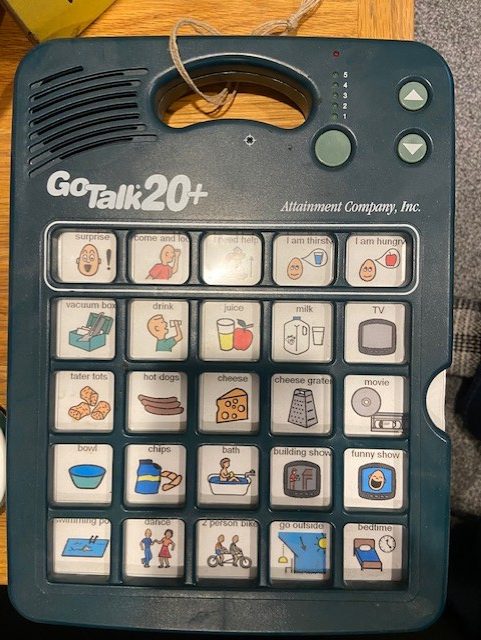
This is what it looked like for Dallin.
He chose to use something, such as what you see here, for quick chats across the house.
Then he would follow up with sign language and gestures and another AAC device that had additional language, if needed.
All of this came over time and while following Dallin’s lead and looking for answers aligned with learning.
Before, the learning took place over time.
That can now happen through places like the Utah Center for AAC Excellence.
It is how technology integration can become like crayons and how we do things every day.
It is how technology integration can indeed become like crayons in the classroom and part of how we do things every day.
It is how we did things in our home, in our world.
It is how I do many things now while living with the chance to pay attention to small things, being aware of how I can continue today with the curiosity for ongoing learning.
Additional
- I was shown how AAC could support our son. I shared it here on the Podcast: How AAC Devices Can Connect Your Child to the World